Facing opportunity gaps intensified by disrupted learning and decades of unproven literacy instruction, students require more individualized support and teaching. As educators address reading proficiency rates, many turn to proven science of reading programs to accelerate literacy learning and make learning equitable for all students.
Let’s examine the core aspects of a high-quality, evidence-based reading program, what the science of reading can do for you, and three ways Lexia's science of reading solutions can accelerate literacy gains for your students.
The science of reading provides proven, evidence-based best practices for teaching reading and supporting students of all abilities. With evidence-based instruction, students and teachers do not waste time on unproven practices.
The Challenge
What is an effective science of reading solution?
Trusted by thousands of school leaders and educators countrywide to accelerate literacy growth for all students.
8.8M+
K-12 Students
599K+
Educators
24K+
Schools
“Lexia Aspire® [Professional Learning] is just amazing. It directly aligns to the goals we have in the district for the science of reading—it exceeded our expectations.”
– Tiffany Goodman, Director of Multi-Tiered Systems of Support, Friendship Charter Schools, Washington, D.C.

Science of Reading for Every Student and Educator
Working hand in hand with administrators and educators, we help create equitable learning opportunities through the effective implementation of the science of reading.
Lexia for School Administrators
Create equitable literacy learning for all of your schools’ populations.
Promote School EquityLexia for Teachers
Close literacy opportunity gaps and build lifelong learners.
Support Student SuccessNot Every Solution is Equal
What To Look For in a Science of Reading Program
Most reading programs now claim to support the science of reading and a Structured Literacy approach because of efficacy. Not every solution is equal. EdWeek1 found most popular programs didn’t accurately align with the evidence. They involved options such as cueing or other clues to help learners guess a word's definition or context.
The best reading programs include a breadth and depth of science of reading-based instruction and knowledge that support every student and educator. A solid solution must include:
- A comprehensive suite of professional learning where teachers develop science of reading expertise and bridge their knowledge to practical, daily classroom support.
- A curriculum that builds in sequence and helps students master foundational skills and fully comprehend all types of text.
- Embedded, dynamic assessments that evaluate student ability in the moment, so teachers can provide precise instruction when students need it most.
Why is this so critical?
Because 67% of all school-based reading in the 10th grade comprises unique, academic language. A student can’t follow directions for an algebra problem if they are still trying to sound out or make sense of the words in the problem. Nor can a young adult understand complex language in job applications or medical diagnoses if they are preoccupied with decoding syllables.
Factors Influencing Reading Comprehension
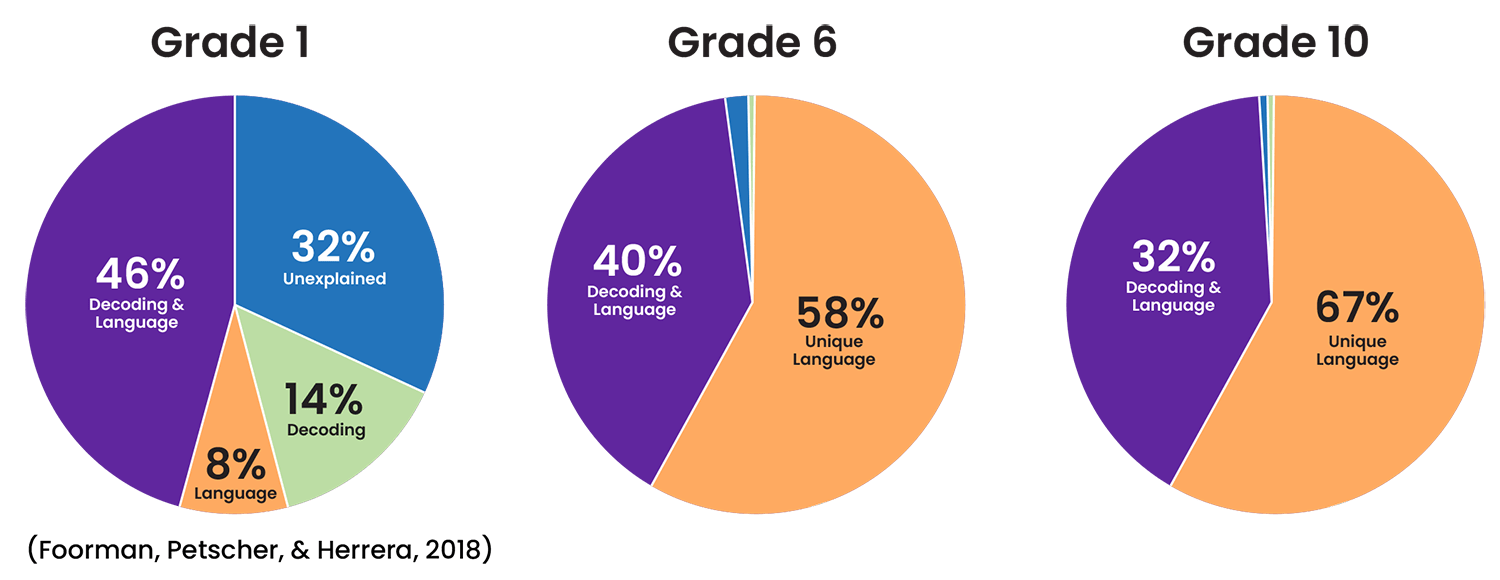
Lexia’s evidence-based instructional solutions have been proven effective at scale in diverse school settings and meet the rigorous eligibility and accountability standards for the Every Student Succeeds Act (ESSA). Learn more about applying the science of reading in your district today.
Majority of States Have Implemented Evidence-Based Reading Instruction Policies
38 states and the District of Columbia have passed laws or implemented new policies related to evidence-based reading instruction as of April 29, 2024, according to a recent Education Week analysis.3
Learn more about applying the science of reading in your district today.
Lexia’s evidence-based instructional solutions have been proven effective at scale in diverse school settings.
Lexia’s evidence-based instructional solutions have been proven effective at scale in diverse school settings.
Three Ways Lexia Science of Reading Solutions Translate to Real Gains
Educational equity can only be achieved with one critical component: Instructional equity. Structured Literacy is the application of the science of reading into usable classroom instruction. Lexia® supports this in three distinct ways.
Connecting teacher knowledge to proven instructional resources is key to accelerating learning.

Empowered Educators
Surprisingly, only 51% of pre-service teaching includes the science of reading. Most professional learning does not prepare educators and leaders for a Structured Literacy approach in the classroom—much less across schools and districts.
Lexia’s professional learning solutions help teachers and administrators understand and apply the core principles of the science of reading throughout early and into secondary education. The LETRS suite prepares pre-K–5 educators and administrators as literacy and language experts in the science of reading. With LETRS, teachers master the nuances of differentiated instruction. It was pivotal in moving the needle in Mississippi, and recently, in Kentucky, 92% of educators said LETRS4 helped them better meet the diverse learning needs of early readers.
For educators of adolescent students, Lexia Aspire® Professional Learning provides a flexible, self-paced, digital solution aligned with the science of reading. More than 250 districts adopted Aspire within just one year of its launch.

Engaged and Proficient Learners
When students feel successful and find school matches their interests, they buy in and get motivated. That’s why science of reading solutions should break down the research into practical classroom instruction that can be personalized for every student. Best practices for Structured Literacy include explicit, systematic, cumulative, diagnostic, and responsive instruction. Lexia® Core5® Reading and Lexia® PowerUp Literacy® use Lexia’s Adaptive Blended Learning model to adjust instruction dynamically so teachers pinpoint individual skills more quickly. The real-time student performance data in Lexia’s patented Assessment Without Testing® (AWT) automatically evaluates students in the moment so they keep working while teachers get precise feedback about student progress.
The results:
Core5 is proven to be more than 2.5 times more effective5 than other elementary reading programs.
PowerUp is up to 5 times more effective6 than other middle school programs. In just one school year, students who used PowerUp showed a 35% improvement in reading skills.

Effective Support for English Learners
Evidence also shows Emergent Bilingual students learn English more quickly when using programs aligned with the science of reading. For students whose native language isn’t English, the explicit instruction in phonics and other foundational components helps them better understand the mechanics of English for deeper understanding.
Emergent Bilinguals who used Core5, for example, progressed 4x faster7 than those without. Across the country, students accessing Lexia English Language Development™ tended to score higher on English language proficiency assessments. Not to mention, students felt accepted because heritage languages and cultures are celebrated as assets in Lexia English. That sense of belonging helps encourage reticent students to speak up and share their knowledge.
Lexia is ESSA Research Proven
Overall, the best science of reading programs prove effective at scale in diverse school settings and meet the rigorous eligibility and accountability standards for ESSA. Lexia provides third-party validation and tangible performance results, including earning ESSA Strong ratings for Core5 and PowerUp.
Lexia provides third-party validation and tangible performance results
Lexia provides third-party validation and tangible performance results
You Might Also Like
Related Lexia Products


Request Information
Ready to learn more about how our science of reading-based solutions can help support the goals of your school or district? Complete the form to reach one of our experts.
This site is protected by reCAPTCHA and the Google Privacy Policy and Terms of Service apply.
A Cambium Learning® Group Brand
