
3/31/2026
What Is Background Knowledge in Reading? How To Build Background Knowledge for Better Reading Comprehension
There is an ongoing discussion about whether search engines expand or narrow worldview. By searching online, one can learn anything—much like reading. Your results, however, get filtered based on personal search history, sometimes leaving out valuable details and historical relevance that narrows our understanding. What’s that adage? You don’t know what you don’t know.
Like search results, reading comprehension is limited or expanded by students’ background knowledge—filtered by experiences, past learnings, and cultural ties that drive big-picture thinking. How well students link texts to larger ideas depends on how much background knowledge they build. It is a vital but often overlooked foundation for unlocking reading proficiency, an important aspect of the science of reading, and essentially absent in U.S. schools today.
If you want to improve reader comprehension, then educators must help all students expand their lens. This article explains what you need to know about background knowledge, why it matters, and simple ways to create classroom routines using a science of reading approach.
What Is Background Knowledge in Reading?
Simply put, background knowledge is the know-how students bring to the classroom, informed by their interests, communities, and culture. This prior understanding forms a “mental framework” of facts and concepts that helps them make sense of new information. Think of it as a learner’s hidden toolbox for growth, filled with lived experiences, worldly knowledge, and subject matter expertise gained in school.
Students arrive with a full spectrum of background knowledge—and that matters. It directly influences reading comprehension. Decades of research show students with relevant background knowledge understand texts more easily, make stronger connections, and draw deeper inferences, especially as reading becomes advanced.
Background Knowledge and the Science of Reading
Science of reading research explains that the brain learns reading skills in progression, and for success, students must be taught explicitly and systematically. Background knowledge is an essential component of language comprehension, and it also must be taught with intention, according to the research. Scarborough’s Reading Rope specifically names background knowledge, alongside vocabulary, language structures, verbal reasoning, and literacy knowledge as progressive strands that make up language comprehension.
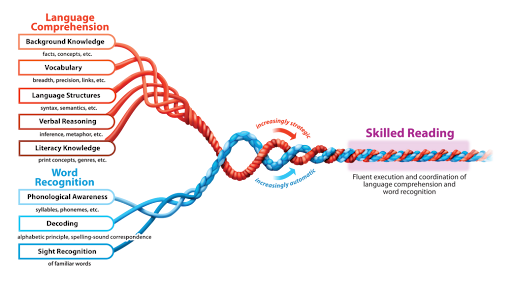
Scarborough’s “Rope” Model from Handbook of Early Literacy Research, © 2001 by Guilford Press.
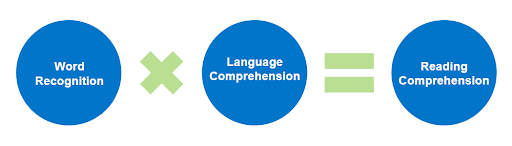
The Simple View of Reading simplifies this more clearly: Reading comprehension is the product of language comprehension and word recognition (decoding). Throughout the years, many educators have understandably concentrated on the mechanics of phonics, phonemic awareness, and decoding. But when language comprehension is thin, and there’s limited background knowledge to draw on, students struggle with reading comprehension.
Why Background Knowledge Matters for Reading Comprehension
The International Dyslexia Association® explains: “We use it to make sense of almost anything we read.” Experts say the future adults sitting in your classrooms today will not fully comprehend future newspapers (or whatever they become) without a broad base of vocabulary and historical, cultural, and world knowledge. Literature, nonfiction, and news make assumptions about common knowledge of the events that shape the world, and readers need to know the context. Think of Shakespeare and The Diary of Anne Frank.
It is shown that students with background knowledge comprehend more, learn vocabulary faster, and retain information better, in part, because it reduces cognitive load, allowing readers to make connections without stumbling over definitions or basic meaning-making. For instance, a student whose hobby is trains will know more related vocabulary, grasp details more quickly, and piece together meaning when the author doesn’t explain why the train whistles—even if that reader struggles with decoding. However, a student who has never seen or learned about steam engines will have a steeper hill to climb: less vocabulary, unaware that steam engines whistle instead of blow horns, and fewer contexts for connections the author doesn’t explicitly state, no matter how fluently the student can decode words.
Relying on prior knowledge gives students a tool for compensating for skill limitations—a crucial reason why science of reading-based instruction prioritizes building background knowledge systematically across all grade levels.
The Background Knowledge Gap and Its Impact
Students who lack a strong base of content knowledge start at a disadvantage, and the gap widens as they advance in school unless explicitly taught by their teachers. Knowledge compounds, creating a cycle of growth. More vocabulary and topic knowledge lead to more advanced reading, which sparks more learning. Yet a limited vocabulary restricts access to more advanced reading, slowing growth and contributing to what some experts say is a vicious downward cycle. This is evident on the world stage. U.S. literacy rates trail many high-performing nations, alongside persistent gaps in science and math achievement.
Adding breadth and depth of content for all students is how to build background knowledge and close achievement gaps, making it a rising tide that lifts all boats.
How To Build Background Knowledge Through Classroom Practices
The most effective way to increase background knowledge and reading comprehension starts with a long-term curriculum that charts a path—starting in the earliest grades—and intentionally layers in rich subject matter with purpose. The good news: Educators do not have to recreate the wheel. Your science of reading curriculum provides a road map for how to build background knowledge. The same evidence-based strategies can be combined with content-rich lessons so all learners expand their world knowledge along with specific subject-matter expertise. Use these key strategies to move from simple concepts to more complex ones with intention, as reading science recommends.
1. Build Knowledge Through Content-Rich Curriculum
Recent research by Kim and colleagues (2023) supports that content-rich instruction gives students a leg up on comprehension, giving them a “schema” to organize, gain, and use their knowledge. Organizing reading instruction around coherent themes can be an effective strategy for how to build background knowledge with intention.
For example, a spiral curriculum introduces young learners to foundational ideas, then later revisits them in more complex concepts beneath the same theme. Early learners, for instance, read age-appropriate stories about polar bears, indigenous people, and igloos, laying the groundwork for a deeper study of Arctic ecosystems in later grades.
Here are some popular themes broken down to building blocks and bigger concepts you can try.
Theme | Basic | More Complex |
|---|---|---|
Ancient civilizations | honey bees, farming, maize | Mayans, terrace farming, agriculture |
Space exploration | stars, planets, rockets | gravity, rocket propulsion, solar systems |
Ecosystems | oceans, whales, starfish | reefs, tides, invertebrates |
2. Use Read-Alouds and Shared Reading
Read-alouds are a powerhouse for expanding content knowledge and shoring up reading skills, exposing students to:
More complex vocabulary
Varied sentence patterns
New content
Selecting diverse texts for read-alouds also is how to build background knowledge about foreign places and cultures. This can be true for the youngest learners, too. For example, the children’s book Mama Do You Love Me? introduces students to animals like whales, puffins, and sled dogs. It also introduces the Intuit culture and native words like “muckluck”—background knowledge for social studies topics about Native Americans, geography lessons about the Arctic, and more. You can also use read-alouds as opportunities to model thinking out loud by pausing to ask questions that build deeper understanding.
3. Leverage Multimedia and Direct Experiences
Virtual field trips and hands-on experiences create connections and powerful experiences that drive deeper understanding. One can read about indigenous cultures, for instance, but watching a video or attending a powwow is unforgettable.
When students can’t experience things firsthand, multimedia is a great alternative. Consider using videos, picture galleries, or other visual content before reading to build familiarity and improve comprehension—and get students excited, too.
4. Teach Vocabulary in Context
Choosing varied and complex texts—including biographies and historical fiction—enriches student perspectives and is a great opportunity to teach vocabulary in context. Teachers can model “figuring it out” by asking questions about difficult vocabulary and working with students to find answers in the text. The approach aligns with the science of reading, ensuring vocabulary is not taught in isolation and background knowledge is built at the same time. These evidence-based reading strategies, including semantic mapping and multiple reads, also help expand vocabulary through context.
How To Build Background Knowledge With Pre-Reading Strategies
Students often need explicit guidance in learning how to tap into their existing knowledge or identify what matters most in the text. Pre-reading strategies build confidence and help students learn what they’re looking for, connect new material to prior learning, and get to know text structure immediately before reading. Try these four strategies to get started.
1. Preview Text Features
Take a few minutes to walk students through preview headings, point out images and captions, and read a few important quotations. You can also point out story structure or content categories (events, themes, settings). Doing so gets students excited and prepared for what they are about to read while building background knowledge.
2. Use KWL Charts
KWL charts are an effective tool because they prime student brains for new information, asking them to consider:
What they Know
What they Want to know before they start reading
What they’ve Learned when finished
Having students create a column for K, W, and L as a note-taking technique reinforces learning through writing. You can also encourage class discussion by modeling the exercise or having students share their KWL Charts in small groups.
3. Show Visual and Multimedia Supports
Visual supports like videos, graphic organizers, and pictures are especially powerful for multilingual learners and students with limited background knowledge because they provide context without relying heavily on word recognition. Consider storyboarding the plot, visually mapping out key characters and their relationships, or using primer videos (like a movie trailer) to get started.
4. Facilitate Pre-Reading Discussions
Talk matters. Intentionally lead discussions, keep students engaged, and provide opportunities to share personal experiences and connect with others. Think-pair-share activities team students together to consider what they know before starting the texts, and discuss with a partner or in a small group. These can be done using KWL charts or simple questions to begin. Guided class brainstorms also demonstrate thinking out loud, getting students to start thinking about what they’re learning (metacognition), building their awareness, and understanding alternate points of view.
Building Background Knowledge Across Different Subjects
Not only should texts be content-rich, but they are also more effective when coherently sequenced. In practice, that is what background knowledge is in reading. Meaning, reading instruction should support learning across social studies, science, and math. As noted earlier, a content-rich curriculum exposes students to vocabulary and concepts they will use in those areas, thereby deepening reading comprehension and overall learning. Making cross-curricular connections also helps students transfer understanding, for example, applying scientific concepts to problem-solving in math. The process unlocks more opportunities for teachers to explicitly teach building background knowledge, protect time for social sciences, and free English Language Arts instruction from being siloed.
Supporting All Learners in Building Background Knowledge
The same also holds true for diverse learners. Research shows multilingual students can transfer many skills from their first language, heritage, and culture as they develop literacy in English. Teachers can tap into their built-in knowledge to strengthen comprehension and help students feel seen. Like some students with neurodivergent learning differences, multilingual learners often have strong conceptual understanding even when their English vocabulary is still developing—they know more than they can yet express. Start by identifying the background knowledge students bring, and then target specific reading skills. Evidence-based comprehension strategies and multisensory supports, especially visuals introduced right before a lesson, are how to build background knowledge and connect new learning.
Assessing Background Knowledge and Measuring Growth in Reading Comprehension
To understand what students know before teaching, informal checks go a long way. A quick pre-reading discussion, a simple concept map, or a five-minute quick-write can reveal what background knowledge is in reading for students and where the gaps are. Pay close attention to students who decode fluently but still struggle to explain or analyze a text; that often signals a knowledge gap, not a skills deficit. Throughout time, growth shows up in richer vocabulary, stronger connections, and deeper questions, not just higher comprehension scores.
Strengthen Reading Comprehension With Lexia
Developing background knowledge is a long game, and the payoff compounds year after year. Reading comprehension grows, or stalls, based on the knowledge students gain. For stronger, more informed readers, explore how Lexia’s science of reading solutions help you build foundational skills, leverage ongoing learning, and boost reading comprehension.

A Cambium Learning® Group Brand
