
9/14/2026
The “L” in LETRS Is for Language! | Part Three: Teachers Need Language Knowledge—Not Just Programs
By Dr. Louisa Moats
In 1994, I wrote a first paper decrying my graduate students’ unfamiliarity with language concepts, titled “The Missing Foundation in Teacher Education.” My focus at the time was on the aspects of language that must be taught explicitly to support decoding, word recognition, and spelling:
Phoneme awareness
Letter recognition
Orthographic pattern awareness
Morphology
Word origin (etymology)
My students, who were otherwise exemplary educators, had not been trained to detect or analyze children’s problems processing language at the sound, syllable, morpheme, or word level. Thus, these otherwise talented teachers could not pinpoint their students’ instructional needs even though they may have used programs that addressed the general domains of phoneme awareness, phonics, word reading, and fluency.
The Missing Links
In 1994, I likened the situation to licensing surgeons without giving them training in human anatomy. Thirty years down the road, my perspective on the “missing foundation” has evolved. Research consistently shows that students who begin reading instruction with weak phonological skills often need support in related areas of language development as well. A broader approach to linguistically informed screening and instruction can strengthen these interconnected language systems. For example, students who are flagged on screening tests of phoneme awareness, letter recognition, and letter-sound correspondence may also:
Read the Full Series
- Part 1: Why the “L” in LETRS Matters More Than Ever
- Part 2: Early Language Development Predicts Literacy
- Part 3: Teachers Need Language Knowledge—Not Just Programs
- Part 4: What Language-Rich Instruction Looks Like in Practice
- Part 5: Standards, Guidelines, and Policies
Know fewer word meanings
Be less attuned to and attentive to spoken language generally
Be less adept at expressing themselves either socially or academically
In addition, evidence indicates that phonological skill development occurs in tandem with or in reciprocity with vocabulary, experience reading print, and the ability to interpret and produce sentences. Each aspect of language learning supports others.
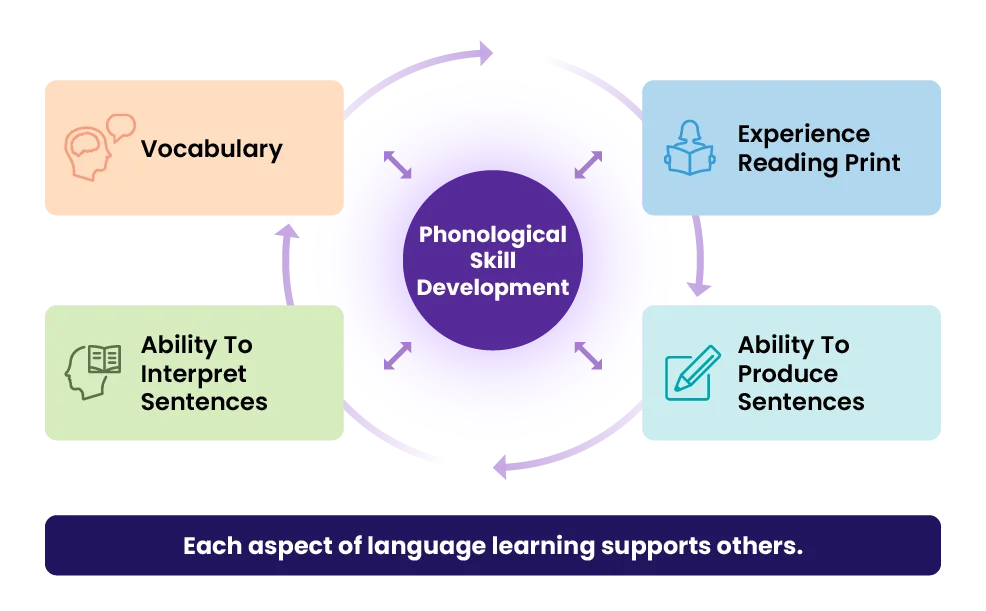
Thus, we err when we assess or instruct single aspects of language without considering others. We err when we teach elements of language in isolation. Linking sound, meaning, spelling, and usage is a better practice than teaching any one of these without the others. For example, a lesson on a new vocabulary word is better if students have heard the word in several phrases or sentences, pronounced it themselves, put it into sentences, seen its spelling, and examined its relationship with other words. Words are known in connection with other words—either in semantic word families that exist in a web of meaning (e.g., words having to do with water) and/or in a morphological word family (e.g., aqua, aquanaut, aquarium, aquamarine, aqualung). Most importantly, words are known by how they are typically used in sentences.
Closing the Gaps
While about half of educator preparation programs are now including adequate information about the “five essential components” of reading instruction, according to the National Council on Teacher Quality, many teacher preparation programs still do not provide sufficient preparation in evidence-based reading instruction, leaving many new teachers underprepared to implement language- and literacy-focused instruction with confidence.
Lexia® LETRS® seeks to address all core language systems essential for literacy acquisition: phonology, orthography, morphology, syntax, semantics, and discourse. The content, videos, and application activities are tailored to teachers of reading and writing. After completing LETRS, teachers should be ready to deliver structured language lessons that integrate and address all aspects of language learning.
References
1. Moats, L. C. (1994). The missing foundation in teacher education: Knowledge of the structure of spoken and written language. Annals of Dyslexia, 44(1), 81–102.
2. National Council on Teacher Quality. (2026). Teacher Prep Review: Decoding Progress in Reading Preparation. https://www.nctq.org/research-insights/decoding-progress-in-reading-preparation/
A Cambium Learning® Group Brand
