
9/14/2026
The “L” in LETRS Is for Language! | Part Four: What Language-Rich Instruction Looks Like in Practice
By Dr. Louisa Moats
Teachers often have little say over which instructional materials or programs they have been given to use. For example, there may be no alignment of terminology, teaching routines, or scope and sequence among programs adopted by a district or school for regular classroom or intervention instruction. Often, the burden is on the teacher to supplement or modify lessons to meet the needs of individuals. Teachers who know about the layers of language and how they can be addressed are best equipped to support their students’ reading and writing progress.
Structured Literacy + Language Instruction
The most effective teaching integrates the essential components of Structured Literacy. Word study incorporates phoneme awareness, phonics, morphology, and spelling in coherent lessons that link one element to another. As words are learned, they are practiced in speaking, reading passages, and meaningful sentence writing.
Read the Full Series
- Part 1: Why the “L” in LETRS Matters More Than Ever
- Part 2: Early Language Development Predicts Literacy
- Part 3: Teachers Need Language Knowledge—Not Just Programs
- Part 4: What Language-Rich Instruction Looks Like in Practice
- Part 5: Standards, Guidelines, and Policies
Phoneme awareness exercises target the specific sounds that will be taught in the phonics lesson; phonics includes the study of meaningful word parts as appropriate; words read singly are pronounced and put into passages read for accuracy, fluency, and comprehension; and spelled words are incorporated into written sentences. Fully integrated language lessons must often be engineered by a teacher who understands the importance of each component, how it is related to the others, and its likely impact on student learning.
The Instructional Needs of Language
Compare traditional “flash card” drills on common words with an approach that encourages students to focus on aspects of language rather than strings of letters. Rather than relying on visual imprinting, the linguistically oriented approach encourages students to think about what words mean and how they are used, employing tasks such as:
Explain the meaning and use the target word in several phrases and sentences
Compare how the word sounds with how it is spelled, mapping the phoneme-grapheme correspondences
Examine the word’s spelling with reference to the word’s history and meaning
Relate it to other words sharing the same root or base
Distinguish it from other similar words that do not share that root or base
Read and write the word many times and use it in self-generated sentences
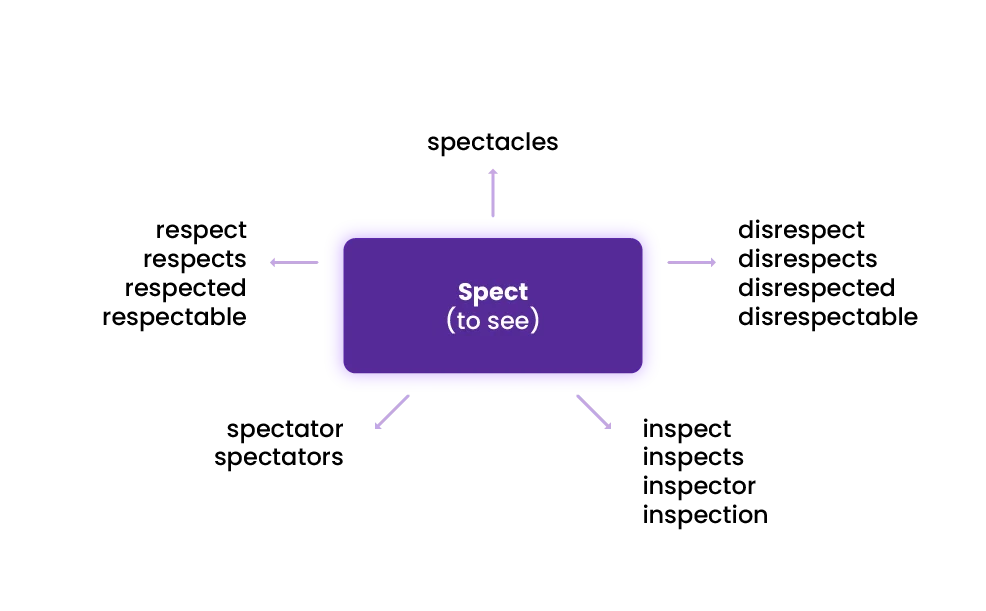
To target higher-level comprehension, using a challenging text, teachers need to anticipate which words, phrases, and sentences are likely to be unfamiliar to their students. Activities such as categorizing words, scaling their meanings on a continuum, or mapping multiple meanings can be employed alongside text reading to support deeper word learning.
Exercises such as identifying the referents for pronouns or identifying the meaning of connecting words can be embedded in shared readings, modeled, and discussed. Writing in response to reading can be guided, step by step, with composition strategies modeled and rehearsed. By eighth grade, we want students to discern an author’s intent, extract the gist of a passage, analyze deeply the relationships among ideas, summarize, and synthesize—and the seeds for this accomplishment are the words, letters, and sounds learned in kindergarten.
If we want teachers to provide such instruction beyond the guidance of their school’s published program, we must empower them with knowledge of scientific research and familiarity with language itself. Lexia® LETRS® aims to help teachers move beyond simply implementing such insufficient programs to become knowledgeable instructional decision-makers who can adapt teaching to meet students’ needs.

A Cambium Learning® Group Brand
