
6/18/2026
Orthographic Mapping: Connections Lead to Literacy Success
Proficient readers rely on automatic word recognition rather than sounding out every word they encounter on a page. When students utilize orthographic mapping to connect spoken sounds to written letters, they can read words instantly without decoding. These connections are permanently stored, so the reader can instantly read the word without needing to sound it out and map each sound to a letter. However, this process, called orthographic mapping, doesn’t happen spontaneously. To read proficiently, students must master phoneme-grapheme mapping and advanced phonological awareness skills. This blog discusses orthographic mapping, its role in literacy acquisition and instruction, and how phonological awareness supports this process.
What Is Orthography?
Orthography refers to a language's writing system, or how words are spelled or written. English requires mastering sound-symbol associations, in which 26 letters represent the 44 phonemes of spoken language. There are different patterns of constraints that will influence the pronunciation of letters in words.
A letter may represent one phoneme or sound, as in b=/b/ or d=/d/.
A letter may represent more than one phoneme, as in c is pronounced /k/ before a, o, u, or a consonant (cat, cot, cut, crust), but /s/ before e, i, or y (cent, city, fancy).
Some constraints in English orthography include:
English words don’t end in i.
The letters ck don’t occur at the beginning of a word.
Irregular words, often taught as "heart words," such as said and enough, require explicit instruction in their unique spelling patterns.
By explicitly teaching your students these patterns, you can help them map most words in the English language. Almost half of all English words can be spelled with a direct one-to-one phoneme-grapheme correspondence, and fewer than 4% are true exceptions that must be memorized (Moats, 2020). When in doubt, sounding out unfamiliar words rather than guessing them yields better results for all readers.
By strengthening students’ orthographic mapping processes, you can help students make the switch from learning to read to reading to learn.
What Is Orthographic Mapping?
To read text, students need to be able to map it to spoken words. The term “orthographic” comes from Greek and literally means “correct writing.” Through the orthographic mapping process, students connect correct spelling sequences to words.
Students first must grasp that spoken words are made of sounds that can be represented in written words by letters.
Students must recognize the phonemes in spoken words and understand how to use phonics principles to decode written words, which requires them to develop four processing systems outlined in the science of reading: phonological, orthographic, meaning, and context, when needed for word meaning.
According to Orton-Gillingham, students have mastered orthographic mapping when they can read a word automatically without effortful decoding. The more words they can store or map, the easier reading becomes for them.
Essential Components of Orthographic Mapping Instruction
Orthographic mapping instruction builds the foundational skills needed to recognize written words instantly.
Students build the foundation for sight word vocabulary through activities like segmenting, blending, and manipulating phonemes. Students practice high-frequency words and orthographic patterns to build automaticity, while spelling activities reinforce the connection between sounds and written forms.
Students practice fluency with connected text reading and regular assessment, using immediate feedback to strengthen their skills.
Ultimately, these components support reading fluency development by turning unfamiliar text into instantly recognized sight words.
The Cognitive Process and Stages of Orthographic Mapping Development
Orthographic mapping isn’t a skill that’s taught—it’s a cognitive process essential for learning to read words by sight and spell words from memory. Orthographic mapping involves connecting the sounds of words (phonemes) with their written form (graphemes) and meanings, allowing these words to be stored in long-term memory as "sight words."
When students have orthographically mapped a word, they can relate the letters they see to the sounds they hear. Then, students process letters together as a sight word, which is different from memorizing the way a word looks. Through orthographic mapping, students connect something new with something they already know. For example, young students already know a word’s pronunciation and meaning, and turn a written word into a sight word by attaching the phonemes in a word’s pronunciation to the letter sequence of the word. The pronunciation of the word must be broken into its phonemes, which is why strong phonemic awareness skills are critical to learning how to read.
Here’s a detailed look at the cognitive process of orthographic mapping development, according to Orton-Gillingham:
Phonemic awareness: Advanced phonemic awareness (the ability to hear, identify, and manipulate individual sounds in spoken words) is crucial for breaking down spoken words into their constituent phonemes and linking these to written letters.
Letter-sound knowledge: Understanding the correspondence between letters and sounds allows learners to decode unfamiliar words and eventually encode them into memory as sight words.
Phonological long-term memory: Phonological long-term memory allows students to store and retrieve word sounds, anchoring pronunciation to written forms.
Semantic processing: Connecting a word's meaning with its pronunciation and spelling strengthens its representation in memory, facilitating quicker recall.
Phonemic Awareness and Letter-Sound Knowledge
Phonological awareness includes phonemic awareness, which is foundational for students’ reading and spelling development. While phonological awareness includes recognizing larger units of speech (syllable awareness and rhyming), phonemic awareness refers to a student’s ability to identify, segment, blend, and manipulate the individual sounds (phonemes) and sound sequences in spoken words.
Students develop phonological skills by noticing larger sound chunks in words, such as rhyming words. Then they notice individual sounds in shorter words, starting with the first sound, moving on to the last sound, and finally attending to the middle sound. Once students develop basic phoneme awareness, they can blend and segment words for reading and writing, then connect the phonemes in spoken words to written language.
Linnea Ehri’s 4 Phases of Word Reading Development
Students progress through Linnea Ehri’s phases of word reading as they develop the ability to map sounds to print.
Pre-alphabetic phase: Young students recognize words based on visual features rather than letter-sound correspondences. At this stage, there is little to no orthographic mapping.
Early alphabetic phase: Learners begin using some letter-sound knowledge to decode words. They are developing basic phonemic awareness, such as breaking words into syllables or identifying initial sounds.
Later alphabetic phase: Students start developing automatic sight word recognition. They use more advanced phonemic awareness skills, like segmenting and blending phonemes, that are crucial for orthographic mapping.
Consolidated alphabetic phase: At this stage, students consolidate their knowledge of letter patterns, syllables, and morphemes. They demonstrate advanced phonemic awareness skills and can map orthographic sequences more efficiently, leading to increased automatic sight word recognition.
For students who have difficulty learning to read, targeted interventions focusing on phonemic awareness and decoding skills can enhance their orthographic mapping abilities.
Why Orthographic Mapping Matters for Literacy Success
Orthography plays a crucial role in Structured Literacy, a fundamental component for developing strong reading and writing skills. Structured Literacy is an approach to teaching oral and written language based on the science of how children learn to read. The Simple View of Reading (Gough & Tunmer, 1986; Hoover & Gough, 1990) proposes that reading comprehension is the product of decoding (or word recognition) and linguistic comprehension (or language comprehension). Because inefficiency in one component may lead to overall reading failure, Structured Literacy instruction includes both of the critical components and their underpinning components.
| Decoding | x | Linguistic Comprehension | = | Reading Comprehension |
Translating printed symbols on a page into spoken equivalents is known as decoding. The underpinning components of decoding are phonology, orthography, and morphology. As an example, when students segment the sounds of the letters P, I, and N and blend them to make the word pin, they’re decoding. The ultimate goal of decoding is for students to read with automaticity. As students become fluent readers, decoding instruction only becomes necessary for struggling students.
In a Structured Literacy curriculum, teachers focus on the systematic relationships between sounds and letters in written language. Understanding orthographic patterns helps your students decode unfamiliar words and recognize familiar ones more quickly, while explicit instruction in orthography—including morphology (the study of word parts)—helps them break down complex words and understand their meanings. This knowledge is crucial for vocabulary expansion and strong reading comprehension.
By teaching orthography with other essential elements of Structured Literacy, such as phonemic awareness and phonics, you can ensure your students develop a comprehensive understanding of written language. By taking a Structured Literacy approach to teaching the conventions of written language, including spelling patterns, punctuation, capitalization, and orthographic instruction, you can help all students become proficient readers—including those with dyslexia.
The Role of Sight Words (It's Not Just Memorization)
Sight or high-frequency words include the most frequently used and repeated words in text. Some sight words follow regular phonics patterns, while many are irregular. Your students will be better equipped to remember and recognize words instantly by learning reliable patterns and through repeated exposures. Rapid and automatic sight word recognition leads to more fluent reading, which can lead to improved reading comprehension.
You can use several effective strategies to teach sight words, including:
Multisensory approach: Incorporate various senses to reinforce learning, including “see and say,” tapping out syllables, or table writing. You can also incorporate movement and music to reinforce sounds in words.
Repetition and practice: To expose students to words, incorporate flashcards, word games, or word walls.
Contextual learning: Ask students to identify and emphasize high-frequency words in sentences or stories.
Word families: Help students recognize patterns in words that share similar ending sounds.
Word mapping: Have students break apart words and identify their corresponding sounds and letters.
Technology-based learning: Use apps and games to help students practice their literacy skills.
Instructional Strategies to Build Orthographic Mapping Skills
 Evidence-based strategies for supporting orthographic mapping focus on developing key skills and providing targeted practice in phonemic awareness, letter-sound correspondence, decoding, spelling, and more. Here are some effective instructional approaches:
Develop phonemic awareness: Provide explicit phonemic awareness instruction and embed phonemic awareness activities into daily routines.
Foster letter-sound correspondence: Provide systematic instruction in grapheme-phoneme correspondences and the relationships between letters and sounds.
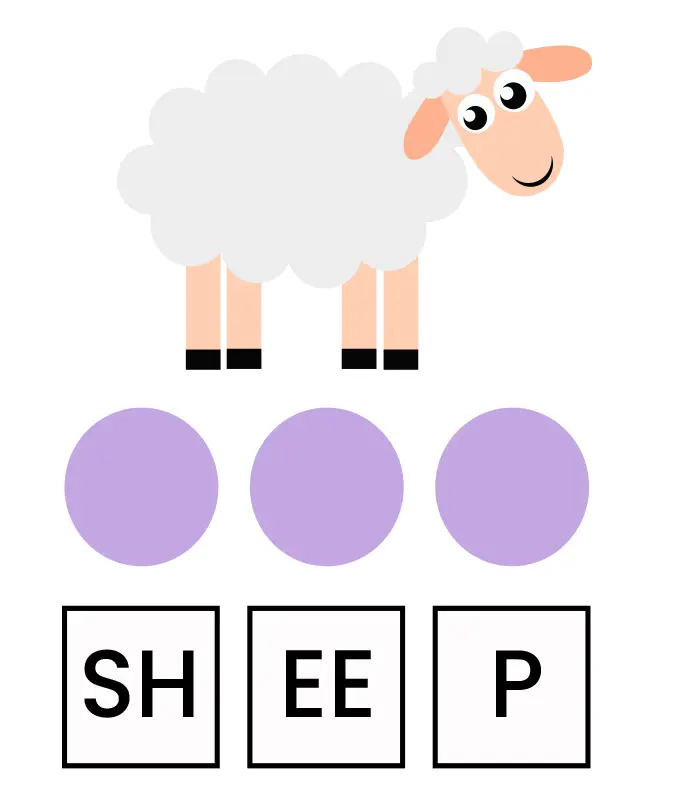
Practice decoding: Use Elkonin boxes, or sound boxes, to help students build phonological awareness by segmenting words into sounds or syllables.
Integrate reading and spelling instruction: Explicitly teach spelling patterns, including spelling rules and words that focus on specific orthographic patterns.
Emphasize word morphology and syllabication: Teach students different morphological elements (prefixes, suffixes, root words, etc.) and show them how words can be broken down or combined with other components to derive meaning or create new words.
Build students’ vocabulary: Help students make connections between newly decoded words and their meanings.
You may have to adjust the amount and type of orthographic mapping practice to meet all students’ needs in small groups or individually. By implementing these evidence-based strategies, you can effectively support the development of orthographic mapping skills, leading to improved reading fluency and comprehension.
Word Mapping Activities (Phoneme-Grapheme Mapping)
Word-mapping activities give students a hands-on way to build the phoneme-grapheme connections that enable automatic word recognition. Rather than asking students to memorize how a word looks, word mapping asks them to analyze how a word works—segmenting it by sound, then linking each phoneme to its corresponding letter or letter combination. Effective activities include:
Sound segmentation with letter tiles or cards
Phoneme-grapheme mapping charts
Word sorting by shared spelling patterns
Pairing decoding with encoding practice
The key is keeping the process active: when students do the mapping work themselves, they build the durable memory connections that function as the "glue" binding a word's pronunciation, spelling, and meaning together in long-term storage.
Using Elkonin Boxes for Sound-Symbol Association
Elkonin boxes, or sound boxes, are a visual and tactile tool that makes the abstract process of phonemic segmentation concrete. To use them, draw a row of connected squares, one per phoneme, not per letter, and have students push a counter into each box as they say each sound in a word aloud. Once all sounds are identified, they return to the first box and write the corresponding grapheme in each square.
Working with sound before print reinforces the idea that spoken words are composed of discrete, mappable units. When students encounter multi-letter graphemes like sh or ea, writing both letters in a single box makes the concept visually intuitive, bridging the gap between what students hear and what they see on the page.
Morphological Awareness and Advanced Mapping
Morphological awareness, including root words and affixes, helps students understand and retain more complex words. Some teachers incorporate multisensory techniques—such as tactile and visual aids—to engage students’ different learning modalities, while others use differentiated instruction to address individual needs.
Assessing and Monitoring Orthographic Mapping Skills
Students need comprehensive, explicit, and systematic instruction to improve their reading and writing. Some basic questions to ask when assessing whether a student is improving their orthographic mapping skills include:
Is the student reading fluently?
Is the student’s words-correct-per-minute rate increasing when reading aloud?
Is the student making errors on spelling tests and in daily work?
Is the student’s spelling improving?
According to Orton-Gillingham, you can assess orthographic mapping skills by evaluating a student’s ability to read grade-level words easily and immediately to determine if those words have likely become “sight words,” meaning they’ve been successfully stored in the student’s long-term memory.
Some literacy programs, like Lexia® Core5® Reading, include embedded assessment tools. Core5’s built-in Assessment Without Testing® monitors the development of students’ reading skills and provides educators with ongoing progress reports.
Professional Development: Enhancing Your Orthographic Mapping Instruction
Most professional learning has not prepared teachers to focus on the skills students need to strengthen their orthographic mapping. Lexia’s professional learning solutions help teachers understand and apply the core principles of the science of reading—including orthography—throughout elementary and middle school.
Developed by Dr. Louisa Moats and leaders in the field of literacy, the Lexia® LETRS® (Language Essentials for Teachers of Reading and Spelling) Suite supports Structured Literacy instruction. LETRS can help you better understand the foundational and fundamentals of reading and writing instruction, including phonological awareness, phonics, fluency, vocabulary, comprehension, and written language.
In upper elementary and middle school, students must have the literacy skills to master more advanced content. A knowledgeable and skilled teacher following a Structured Literacy approach can create a more equitable learning environment for older students. Based on the science of reading, Lexia Aspire® Professional Learning supports teachers in grades 4–8, from content-area and classroom educators to interventionists and ELA educators. Aspire can help you weave literacy skills and strategies into your instruction to better support learners struggling to read, comprehend, or articulate their ideas across content areas.
To discover evidence-based strategies you can learn to strengthen students’ orthographic mapping skills, explore Lexia’s professional development solutions.

A Cambium Learning® Group Brand
