
7/30/2026
Early Literacy Solutions: Strategies to Improve Early Literacy Outcomes
Today’s youngest students are often expected to be able to read by the end of kindergarten. This amounts to a sea change in comparison to previous years, when first grade was considered the typical year for reading skills to take hold. Yet the gap between expectations and outcomes remains stark. In the 2021–2022 school year, only 47% of kindergarteners were reading at grade level—down from 55% just two years prior in 2019–2020. More recent DIBELS data shows modest recovery, but K–2 students are still tracking below pre-pandemic levels overall.
But what are the most effective strategies to improve early literacy outcomes in children so young? Solutions include making literacy education a part of children’s playtime and securing the necessary funding for early literacy programs.
Embedding literacy in play
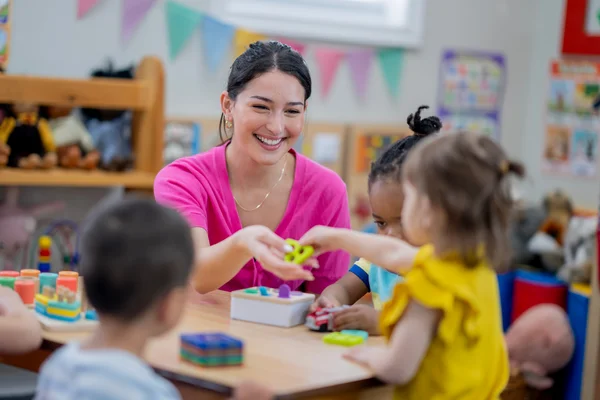
One way for teachers to embed literacy in play involves purposeful classroom design. Dramatic play centers that have literacy prompts and lessons woven throughout are seen by many early childhood advocates as a beneficial way to help young children learn important skills. For instance, a kitchen- or restaurant-themed play area could include many examples of “functional print,” wrote V. Susan Bennett-Armistead in her book, "Literacy-Building Play in Preschool." Items such as “menus, shelf-signs, coupons, and labeled food containers,” along with plenty of writing materials, give young children the chance to “interact with print” in ways that mimic the world around them—and this, according to Bennett-Armistead, leads to “greater literacy competencies.” Citing the research of others, the author noted that the possibilities for setting up such play areas are endless, and this type of approach can help reach many different kinds of children who will ideally be inspired to “include text in their lives, not just in their play.”
Deploying guided play
Such a structured yet play-based approach undoubtedly qualifies as “guided play,” which is defined by University of Pennsylvania researcher Deena Weisberg as a “form of play where children explore within an environment that has been prepared by adults and/or with guidance from adults.” Weisberg runs the Cognition and Development lab at her university, where she says the “fields of developmental and learning science have really just begun to scratch the surface” when it comes to understanding the value of guided play. In Weisberg’s view, a key element of guided play is that it is child-directed, with adults playing the role of informed and interested observers.
Support for understanding what guided play is and how it can both mirror and expand on children’s natural tendencies for growth and exploration appears to be on the rise.
The sweet spot between literacy education and play
There seems to be a sweet spot wherein learning environments for young children can be both play-oriented and content-rich. Too little emphasis on emerging literacy skills might leave children unprepared for further academic tasks, while too much back-to-basics direct instruction might disengage children from their own learning. Suzanne Bouffard, a developmental psychologist who wrote a book about the importance of high-quality preschool classrooms, spent two years observing preschool settings around the country. She noted that marginalized children—often children of color living in poverty—are more likely to receive “skill and drill instruction” designed to help them “catch up” to their more privileged peers. However, this is a deficit-based approach that might emphasize having kids memorize a “random list of words” over helping them gain what Bouffard characterized as knowledge economy skills, such as “curiosity, creativity, and critical thinking.”
Fortunately, there are many resources available to guide teachers and administrators in creating “literacy-rich 21st century classrooms” that do not leave learning to chance; instead, they build upon identifiable goals while still emphasizing hands-on, student-directed activities, including play. This might just lead to a middle ground of sorts, where emerging literacy skills are purposefully and creatively embedded into the everyday lives of both teacher and student.
Finding funding for early literacy programs
This brings up an important point. In an era when funding for public school programs and initiatives—including widespread access to preschool—can be tough to rely on, what should researchers, parents, and education practitioners do to promote the financial development of early literacy solutions? One strategy may be to tap into grants and community partnerships to find the dollars and dedication necessary to start and maintain early literacy programs. For example, the Chan-Zuckerberg Foundation gave $30 million in 2018 to launch the Reach Every Reader early literacy program in partnership with the Harvard Graduate School of Education, the Massachusetts Institute of Technology, and Florida State University. Although the Reach Every Reader approach is broad and still very new, meaning it is too soon to judge the value of using personalized learning strategies or newly developed diagnostic tools to boost literacy rates, the approach is shining a needed spotlight on early literacy efforts.
Among the numerous smaller foundations, grants, and partnerships also being used to address critical early literacy needs, here are a few examples worth considering.
Regional grants tap into unique needs
The Southern Minnesota Initiative Foundation is a philanthropic and community development organization based in Owatonna, Minnesota, just south of the Twin Cities. The foundation has developed a unique way to support parents by hosting mid-day workshops that focus on the importance of helping young children gain essential pre-reading and writing skills. This is only one way to get books into the hands of families, of course, and it does not seek to address some of the underlying socioeconomic barriers that may make it difficult for some parents and caregivers to frequently read with children.
Paying parents
Researchers at Ohio State University discovered an unexpected way to encourage caregivers to read with children: Pay them to do it. Graduate students and educational psychology department members at the university embarked on an exploratory 15-week session designed to see how caregivers can best support the literacy development of their young charges—children who, according to the researchers, were all “4 or 5 years old and had been diagnosed with language impairment.” In addition, most of the caregivers “lived in low-income households.”
Four techniques were tried over the course of the study, including mentoring, support, and the provision of “positive feedback” related to how adults read with children. Paying the adults a modest amount—50 cents per reading session—was found to have the greatest impact on the young children’s reading test scores, to the surprise of the university staff. Lead researcher Laura Justice notes that this clued in her and her colleagues to an important discovery: The small amount of money offered to parents and caregivers in this study was enough to help them prioritize reading and get around the “time pressure” that may have prevented them from consistently reading with the children in their care.
Although paying parents and caregivers to read with young children is beyond the reach of many teachers and administrators, a willingness to think creatively and find new ways to “identify the right barriers” when it comes to early literacy skills could be an important part of supporting the idea that reading is the foundational skill for all school-based learning. From embracing the emerging neuroscience of early literacy to seeking out greater community partnerships, early childhood education professionals may find themselves armed with more evidence and support for their very important work with young children.
Ultimately, there are many resources out there that demonstrate how early childhood teachers and other individuals who work with young children can use everyday moments to reinforce emerging literacy skills.
Next steps in fostering the development of early literacy skills
Lexia can help you take the right next step in developing early literacy solutions for your organization, whether it's designing a literacy-embedded play center, deploying guided play, or finding funding to sustain early literacy programs. Lexia offers research-backed solutions built on the science of reading—including Lexia® Core5® Reading, which delivers personalized, adaptive literacy instruction for students in pre-K–5.
A Cambium Learning® Group Brand
